Community
Village History
History of Foxfire Village by: Max Krebs
How the Sandhills and Pine Barrens Gave Birth to Foxfire
Most of us have come to cherish the environs of North Carolina’s Sandhills and, in particular, the 2200 plus acres encompassing our Village of Foxfire. We are fascinated by bits and pieces of hearsay about the pioneers who visualized our village-cum-country club and when and how they brought their dream into reality.
In 1976, Esther and I took all of one hour to fall in love with Foxfire after twenty-nine years of diplomatic service. Our subsequent twenty years have nourished our fondness for the Village and our neighbors, and we were delighted to be invited to pro-duce this brief sketch of who and what existed here before Foxfire.
The earliest inhabitants were Indians of the Cherokee “nation.” Their presence produced the many finely carved saw-tooth edged arrowheads in collections made by, inter alia, Hawley Poole (of whom more later) and the late Mark C. Liddell, a realtor of Southern Pines.
Beginning in the 18th century came the doughty Scots. They called the region a “pine barren,” and the present Foxfire area “Piney Bottom.” Actually, it’s mostly part of a north-south ridge some 600 feet above sea level and 100 to 200 feet above Pinehurst. The Scots made their living from the pine forest, first from turpentine and then from construction timbers. Thanks to railroads, they were able to find markets for these and other farm produce. One of the smaller “branch” railroads ran from Aberdeen through today’s Foxfire toward U.S. 220. The track actually crossed part of what is now Lake McKenzie and Drowning Creek at the same location as today’s Richmond Road Bridge.
At the end of the 19th century with the beginnings of Southern Pines and Pinehurst, another railroad spur was built to service the popular resort of those decades in Jackson Springs. Along with this phase came changes in agricultural pursuits - farms producing crops of cotton, tobacco, corn, rye and wheat plus vineyards and orchards.
Orchards and vineyards gave Foxfire its 20th century identity beginning just after World War I. A handful of oldsters who grew up in that time are still living in the vicinity and welcomed our inquiries about what happened to the peach tree and the scuppernong muscadine grapes.
I first spent an afternoon with Lee and Beth Smith of Bird Haven Farm on Hoffman road just south of Roseland Road. Some of us remember with pleasure Lee’s elegant “Silver Queen” corn, melons, tomatoes, etc. From 1923 to 1929 the Smiths lived with his parents just beyond where the Foxfire Villas now stand on Richmond Road.
According to the Smiths, in those days peach trees occupied over 300 acres on each side of Richmond Road from Hoffman Road west to today’s Cardinal Drive. Another 20 acres of this tract were devoted to a vineyard of scuppernong grapes; vestiges can still be found left of the fairway on # 15 West. A small tract of tobacco was on the east side of Hoffman Road and cotton, corn and wheat patches elsewhere.
This orchard/vineyard was named Manice (may-ness) Orchard by its Yankee owner E. A. Manice of New York City. Mr. Manice, a South Carolina native who had made a small fortune on the stock market, bought five parcels totaling 2,150 acres in Moore County between February and May 1919, plus another 150 acres in August 1922. He sold off the turpentine already on hand plus a substantial stand of pine trees. With the proceeds he planted the peach trees and grape vines and installed the water supply system, processing barn and housing for the workers.
Irrigation was provided from what is now a part of Lake McKenzie with water self- pumped by a “ram” device to a water tower near the present maintenance area. A packing barn and housing for packers imported from Georgia as well as migratory pickers was also in this area. Peaches were trucked to a railroad siding at the junction of Hoffman Road and today’s NC 211. They were loaded on cold storage cars bound for Yankee land. Lee Smith’s father worked full-time in the orchard. Lee during high school summers remembers trucking peaches to the railroad spur along with Clyde Auman, now owner of the extensive peach orchards along NC 73, and a long time representative in the North Carolina General Assembly.
Another octogenarian, Marvin Hartsell, presently residing on Rose Ridge Road south of Foxfire, added an hour’s worth of recollections about Manice Orchard. His father, Columbus (“Lum”), had a role of jack-of-all-trades for the orchard. Marvin recalls his childhood in their house at the end of the double row of pecan trees stretching from Hoffman Road to today’s site of the Schmolze residence at 8 Deer Track Road. Marvin remembers Hawley Poole, another resident later elected to the General Assembly, who held the job of General Manager for the orchard. Owner Manice would get Poole’s estimate of each annual crop, then return to New York where he was able to sell the entire crop. The price included a “fancy pack,” i.e. each peach tissue wrapped, then packed in wooden crates in rows separated by cardboard cups.
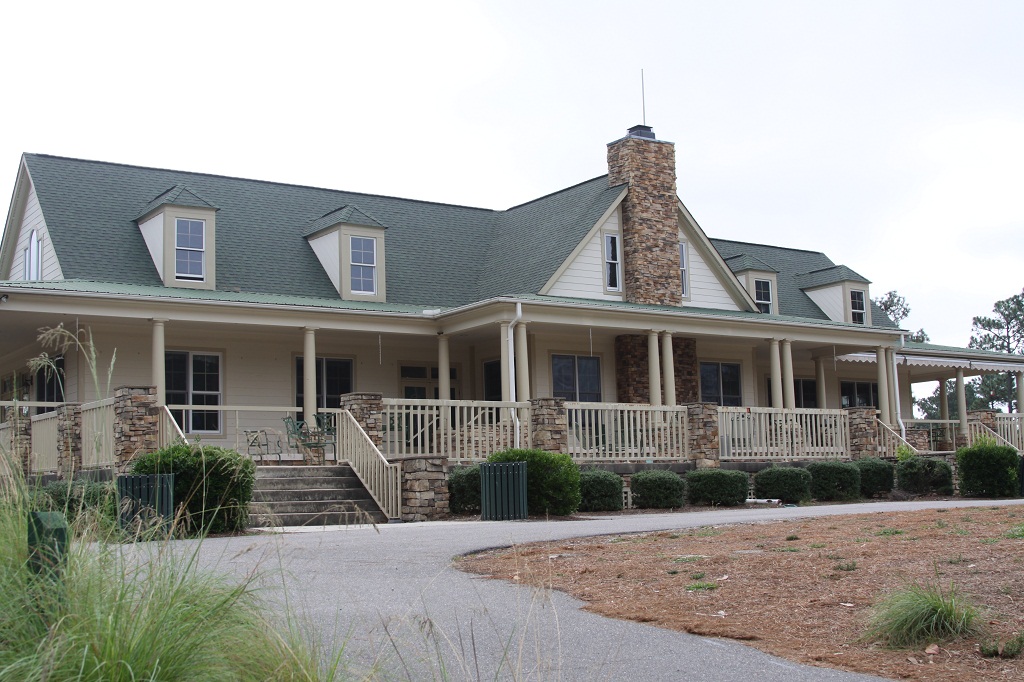
Both Smith and Hartsell remember particularly the Manice’s only child, Dorothy, who married a Mr. Oglesby in New York, and then took up residence in the “Manor.” Today it is the core of the Foxfire Clubhouse. Her husband became the bookkeeper for the enterprise while Dorothy soon picked up a general knowledge of the workings of the project aware that she was the only potential inheritor.
The orchard grew rapidly so that within four years, i.e. by 1923, it was showing a handsome profit. Manice was a shrewd operator and spent a good deal of each year on the premises. However, in 1928 fate stepped in with a devastating late winter frost, which wiped out the entire peach crop. Modern peach operators have learned to make partial financial allowances for such disasters. Manice was caught with a heavy payroll of year- round staff including Poole who had insisted on a twenty-year contract. As the picture grew darker, Dorothy began to suspect that her husband had dipped into the till. She hired an investigator who confirmed her suspicion whereupon she fired Mr. 0glesby and sued for divorce.
In the midst of this early 1929 turmoil, Mr. Manice died suddenly in the packinghouse and Dorothy became the sole owner of Manice Orchard and the other real estate. She decided to close down the orchard, which had only partly recovered from the 1928 disaster. Her first step was to cut down all the peach trees and to plant a mixture of longleaf and loblolly pines wherever each peach tree had been. She moved to Augusta, Georgia, but kept in touch with Poole and Hartsell. Marvin Hartsell recalls she had a yearning for pecans and once asked for a large bag to be sent to her. Marvin and other teenagers collected enough to fill a 200-pound burlap sack, which was then sent by rail to Augusta.
Finally, in 1942, she and James Kerr, the other trustee under her father’s will, sold the entire 2,150 acre estate for $25,000 to Messrs George W. Scott, Hal A. McKinnon and William A. Lewis, all of Biscoe, North Carolina. According to Marvin Hartsell, these gentlemen were lumber dealers. They immediately dismantled all the working buildings and sold the timber followed by mass felling of pine trees except for those replacing peach trees. With kindly help from Judith Adams, Moore County Register of Deeds, I obtained a copy of the 1942 deed which has been added to the Village Hall archives. Little change took place for the next twenty-odd years until the mid-sixties. A group of well-to-do golf players from Chapel Hill, having observed from airplanes and on the ground the rolling landscape and the now full-grown pines, decided to buy enough real estate to harbor a golf resort plus parcels of three-quarters to one acre lots suitable for residential building.
It was this group who came up with name “Foxfire.” People often ask, “Where did that come from?” The answer is that it began as an English translation of the French phrase “faux feu.” False fire was a phenomenon French explorers found in the swamp lands of the South - a night-time glowing light brought about by the damp air loaded with phosphorous rising at darkness out of the swampy land. For present and future residents, let us think of “Foxfire” as a symbol of the glow, which surrounds our lives.
The Birth of Foxfire
In the last chapter on the pre-Foxfire history of this area, we cut off in 1942 with the sale of the Manice 2,300 acre tract to three Biscoe lumber dealers. The next major development came in 1955 with - hallelujah! - another peach orchard and grape vine- yard.
This time the prime movers were Roland and Louise MacKenzie of Cockeyesville, Maryland, a suburb of Baltimore. Roland was a nationally well-known amateur golfer who became interested in the Pinehurst area and was active in setting up the Royal Dornoch Golf Village, today known as Country Club of North Carolina (CCNC).
Anyone coming to the Sandhills, as Mrs. Krebs and I did in 1976, soon becomes accustomed to the Scottish flavor of the area. Hence, the MacKenzie name came up often as we became acquainted with Moore County and the Sandhills. However, it wasn’t until I took on this historic project that I decided on a pilgrimage to the Tufts Archives in Pinehurst to obtain material on the MacKenzies. Librarian Christine Januzik promptly handed me a biography titled “Roland” by John W. Stewart.
One of the first items to catch my eye was a page of photos and text about “Shamrock Farms” which the MacKenzies established in 1955 on a large piece of the earlier Manice orchard. One photo depicted an aerial view of 300-plus acres of peach orchards and scuppernong vineyards on either side of Richmond Road from our Foxfire Boulevard west well beyond its first curve.
From there I went again to the Registry of Deeds in Carthage. I found copies of two deeds in March and October of 1955 recording the purchase of a total of 1020.84 acres from Ruth E. Wright (880.84 acres) and Mr. and Mrs. W.G. Jerome (140 acres) by Mr. and Mrs. MacKenzie. These two tracts covered essentially what had earlier been the Manice orchard. Copies of the deeds can now be found in our Village Hall archives.
An intriguing reference in the metes and bounds of the Jerome deed was the first “marker,” a corner of “the Newburg School Lot.” I asked my earlier informer, Marvin Hartsell, about the school. He said the schoolhouse was located in the “triangle” between SR1122 and SRI 123, at a point almost exactly facing our Village Hall. Marvin attended first grade there in 1920, but the school was relocated in 1921 to West End.
I also asked Mr. Clyde Auman, the ultimate authority on Sandhills orchards, what he knew about Shamrock Farms. He noted that in those days many wealthy Yankees came south to cultivate peaches. As for the MacKenzies, he said they were excellent growers and for a decade had successful crops and sales. He mentioned particularly a late frost in 1964 which did great damage to his crop. Shamrock Farms had a good deal less crop-loss and MacKenzie sold him a part of the Shamrock crop at a rea-sonable price. He also remembered that when MacKenzie eventually decided to sell his land, he told Auman he was going from “peach freezes” to “golf downpours.”
The real impetus for a golf development in our area, however, came from a group of enthusiasts in the Chapel Hill area. Roger Elton in his Village Observer article of May 1984 on this subject spoke of a “legend” regarding Jack Vernon, a real estate broker, and golf pro Ed Kenney flying over the MacKenzie property sometime in late 1964 or early 1965 en route home from Myrtle Beach, they became enchanted by Lake MacKenzie, the hills, tall pines and an open expanse suitable for an airfield. Being gung-ho types, they recruited a Chapel Hill attorney, James C. Harper and an investor living part-time in Chapel Hills, Charles E. Magowan, as a team of co-principals to pursue the concept and material details of a project to install a golf development in that area.
During 1965-66, they conducted preliminary feasibility studies as to physical requirements and financing of a golf course, recruiting of members, etc. They also nego- tiated an option, valid until December 15, 1966, for purchase of the land at a price of $350,000. They also announced their project title: Foxfire Development Corporation. During this interim, the MacKenzies on September 23, 1965 set up a Deed of Conveyance of their orchard property to Richard B. Barkley, J. Harvey Wicker and Fitzgerald S. Hudson. This was changed in December 1965 via a release of the property to a Limited Partnership of the same parties, plus Attorney W. Lamont Brown, titled Shamrock Associates. Shamrock Associates was identified as a Limited Partnership, with R.B. Barkley as President of the General Partner, Shamrock Hills, Inc. Subsequent developments indicated that the object of the partnership was to provide the MacKenzies with a means of control over Foxfire Development Corporation.
In any event, by 1966 Foxfire Development Corporation had been established in Chapel Hill by Messrs. Vernon, Kenney, Harper and Magowan. In a Development Prospectus they authorized initial capital of $500,000 to be raised by sale of 50,000 shares of Class A common stock at $10 per share. To cover their preliminary expenses, they issued themselves 4,750 shares as follows: Vernon - 1,600, Kenney - 1,000, Harper- 700 and Magowan - 1,450. This left 45,250 shares for sale. The shares already issued, plus a target sale of 30 to 90 Charter memberships, each buying 500 or more shares, would bring the capital to between $194,500 and $497,500. Charter Members making full payment would be entitled to one “choice” lot, lifetime free membership, and an option to purchase further shares. Even in those days at $5,000, a three quarter acre lot on the golf course was a stunning bargain. The development plan contemplated three phases:
18 hole championship golf course with club and supporting facilities, including use of an airport on the premises;
500 to 600 residential lots, with paved access roads and utility services.
Future development of hotel and commercial enterprises as feasible.
Financial requirements for Phase I were expected to reach $675,000, i.e. land cost, $350,000; topographic surveys and maps, $10,000; the 18-hole golf course, $300,000 and incidental overhead, $15,000. Title to the land was to be acquired once they had sold 25 Charter Memberships, i.e. $125,000.
The actual Deed of Trust to Foxfire Development Corp. is dated March 1, 1967. It mentions the prior deed to Shamrock Associates, as well as the indebtedness backed by the real estate, i.e. $82,000 to Federal Land Bank Association; $24,000 to Sandhills Production Credit Association and $30,650 to W. Lamont Brown, as Trustee for the Shamrock Associates.
So, what happened? I found at the Registry of Deeds an index devoted exclusively to real estate conveyances by Foxfire Development, beginning in 1967 and going up to 1973. Recorded sales during the six years were 112 Charter Memberships in Phase I and 15 non-Charter sales in Phase II. Also included in the sales were the first condominiums, labeled A,B and C on Foxfire Boulevard in the Clubhouse area, and the Foxhills on Richmond road, east of Pine Tree Terrace. All this added up to roughly $600,000 - apparently a good start!
With these promising sales Foxfire Development began to develop the land, but the saga continues.
The Torrid Teens of Foxfire
Foxfire Development Corporation hired a fine team of Durham’s Gene Hamm as golf course architect and John A. Edwards & Co., land engineers and planners, to lay out and supervise the construction of the golf course, and to subdivide the surrounding land into 168 three-quarter acre residential lots. Also on their agenda was renovation of the Manice “Manor House” into a clubhouse with adequate dining space, plus an addition for a pro shop. The proposed airport was laid out to the west of today’s maintenance area with the main 3200-foot airstrip running southwest. I might add that the “great expectations” for this 100-acre facility did not materialize and the tract was rezoned in 1982 into two-acre horse farms (again, not popular) and regular residential lots.
An important factor regarding the residential lots were the protective covenants accompanying deeds. With few exceptions, lots were to measure at least three-quarter acres with mandatory front, back and lateral setbacks for setting houses. Architects’ plans for all structures were to be approved by the Board of Directors or a designated committee. All told there were twelve specific requirements spelled out in a declaration accompanying all deeds to property purchased from the Development Corporation.
Construction of the golf course began in early 1967 and it was opened for members in December of 1967. A formal grand opening was held in February 1968. The original eighteen holes are today: WEST - numbers 1 to 5 and 15 to 18 and EAST numbers 1-8 and 18. In 1974 another nine holes were added, today’s WEST 6 to 14 and the final nine holes, today’s EAST 9 to 17.
It should be noted that to accommodate the final nine holes Roland MacKenzie and Dan Thomason in 1969 bought 339.5 acres which also allowed later the creation of Foxfire East. This brought Foxfire’s total acreage to 1360.34 of which 880.84 compose Foxfire West and 479.5 Foxfire East. And finally on golf courses, in a negotiation in 1980 with the then owners of Foxfire, Henry D. Mayer, the Village Zoning Board succeeded in earmarking a tract of around 150-175 acres in the southern-most part of Foxfire West, on the west side of SR1004, for an eventual third eighteen hole course.
Already by the end of 1967, even though over 100 lots had been sold, there were dark clouds on the financial horizon. Charter stockholders as of August 1, 1967 had received 115 lots at a cost to the Corporation of $72,000. Beginning with the fiscal year ending June 30, 1968 up to fiscal year 1973-1974 retained losses shot from $23,930 to $401,812.
By 1970 the Chapel Hill investors had exhausted their assets in coping with the steady losses. Lucky for residential property owners there emerged two Foxfire life savers, Roland MacKenzie and Dan R. Thomason, a Fayetteville investor-entrepreneur who had become enamored with Foxfire. In his capacity as vice-president and CEO of the Corporation, Thomason wrote in a letter to shareholders as of August 1, 1973: “At the present time Mr. MacKenzie and I have provided the Company with operating funds in excess of $1,100,000 through our investment in convertible debentures of the Company and our endorsement of Company loans. Moreover, The Company will require additional funds in connection with planned projects, and the lending institutions providing funds for these projects will also require our endorsement of the loans. We do not intend to continue to provide financial support to the Company unless we can purchase all of the remaining shares.” Indeed, they did achieve complete control of the Foxfire Development Corporation with MacKenzie as Chairman of the Board, Thomason as Vice President and CEO, and only two other Board members, both in fact second echelon employees of the corporation.
On a brighter note, this period did produce the swimming pool and two tennis courts, and the main dining room/convention center extension of the clubhouse. Moreover, for a brief interlude (1979-1983) of growth and residents’ satisfaction, Henry D. Mayer who had bought the property from MacKenzie and Thomason and his lieu-tenant, Lovick Suddath, managed to build and sell fifty-six Foxkroft Quad condominiums (thirty six in Foxfire West, twenty in East), four duplex units (two each in West and East) plus the nine golf holes in Foxfire East. The resident community grew at a steady pace with most newcomers building their retirement homes.
Meantime prior to Mr. Mayer’s takeover, retired Air Force Brigadier General Joe Donovan, as Corporation President and builder of numerous homes in the community sought to end our brown-bagged booze in order to improve clubhouse earnings with liquor-by-the-drink. To achieve this goal, he discovered, would require that our community become an incorporated village. Donovan and a group of residents sought the intervention of Clyde Auman, mentioned earlier, who at that time was the Moore County Representative in the North Carolina Legislative Assembly. Fortunately, Mr. Auman was convinced that abuse of liquor could be much better controlled by liquor-by-the-drink, which places responsibility in the hands of proprietors of bars and restaurants, rather than the clerks in the ABC Stores. With his support and bargaining, on April 18, 1977 the incorporation act passed the third reading and we were ON THE MAP! I should add that when the Village began exercising its zoning rights, Joe Donovan, the contractor, was far from the happiest man in town. Nor were some of his successors who gave plenty of headaches to members of the Zoning Board and the Zoning Administrator.
Thanks to national doldrums in 1982-83 and his own over-extension, Henry Mayer bowed out of Foxfire in 1983 with a foreclosure by Carolina Bank. Late that year the Bank sold just the two golf courses and clubhouse facilities to Foxfire Resorts. Shortly thereafter a group of Kentucky entrepreneurs launched First Resort Properties (FRP) to convert some of the Foxfire condominiums into “timeshare units.”
There is an old adage, “If it seems too good to be true, it usually is.” The time-share concept of owning a single vacation week, capable of being swapped for that (or another week), in any of hundreds of vacation spots worldwide, is the epitome of that saying. Part of the lure for the buyer is to purchase one (or two) weeks with a modest down payment, often 10%, and a five to ten year mortgage. Beside the mortgage interest, the only other costs are small fees to the host outfit and a modest annual maintenance fee. For the seller, the gimmick is to find a source willing to purchase the mort-gages on fifty-one weeks per unit, one being reserved for maintenance.
In less than eighteen months FRP converted thirty eight condos into time-share apartments, i.e. 38 x 51 weeks each equals 1938 time-share units. Of the 38, some were in Foxkroft “quads,” others in Foxgreen “row” apartments and five in the tree houses. Suddenly, our 125 residents began to be annoyed by a daily influx of potential time-share owners recruited by phone banks and other “come-on” advertising. Moreover, the slick sales staff inveigled some seventy residents into buying time-shares with the idea of swapping or renting their week and for their lifetime paying only the annual maintenance fee ($150) in lieu of the regular annual greens fee ($1000 or more). We (I, too, succumbed to their salesmanship) soon learned that Carolina Bank refused to ratify the “lifetime” offer. It would be good only during FRP’s tenure.
FRP found its “magic fountain” in Berkeley Federal Savings and Loan Association which was already engaged elsewhere in time-share financing. Soon, the FRP had a stretch limousine, the fabled “Castle” in Pinehurst and a private airplane to fly the mortgage papers to Berkeley in New Jersey. Depending on size and season, time-share weeks varied from $6,000 to $10,000 a week with a down payment of 10% to 15%, which was retained by FRP. Berkeley paid FRP the balance minus 10% for a “reserve fund.” On a $10,000 sale with $1,000 down, Berkeley paid FRP $8,100. Actual sales up to early 1985 were approximately 1,000 unit weeks for an estimated cash flow of $8.5 million for FRP. As the buyers began to find mortgage payments too heavy and to default, Berkeley had a corresponding loss of $4 million due to non-conformity with a provision in the FRP contract that they would repurchase or otherwise repay Berkeley the balance due upon a buyer’s default.
The history of the time-shares will continue in the next chapter. This period of Foxfire’s history is a very sore subject with residents. However, the temptation to ignore it or change it to meet our needs would not be honest.
The Foxfire “Timeshare Fever” and Aftermath
We take up where we left off with the “Time-Share Fever”. Beginning in July 1984 passage of the North Carolina Time Share Registration Act foreshadowed the demise of First Resort Properties. An avalanche of over 300 consumer complaints, plus false statements in FRP’s application for a time-share license, led the Real Estate Commission to a thorough investigation - and the sudden disappearance of FRP management and staff. In November 1984 the Kentucky partners (Terra del Sol) assumed control of both First Resorts and FRP, just as the commission completely shut down time-share sales operations. In December, Berkeley Savings sent a delegation to Foxfire to negotiate with Terra del So! a so-called “workout” agreement.
The negotiations dragged on for five months and it became apparent that Branch Bank (successor to Carolina Bank) was about to foreclose on the golf courses, club house and other amenities. Without control of these elements, Berkeley would have lost its entire investment. So in 1985 Berkeley bought those deeds for $2.1 million. They also advanced $234,000 as part of the Terra del So! “workout” agreement covering both the upkeep and operation of the resort and the time-share operations. Over the rest of 1985 Terra del So! defaulted almost completely and finally on December 4, 1985 simply walked out of Foxfire leaving Berkeley holding a debt-ridden, default-confronted sloppy sack.
Ever since, time-sharing has been a headache for everyone involved. Gradually legal devices had to be invented to cope with “kudzu-like” conglomeration of definitions and constraints governing time-share. For example, North Carolina law defined each apartment (with up to 51 owners) as the legal “interval ownership unit”. With legal and cash help from Berkeley, Foxfire was eventually able to create a single “Consolidated Owners Association” as a management device. However, decisions made at annual meetings had to show attendance records for each of 19 condo units then in operation. Moreover, to sell a given condo requires agreement by or foreclosure against all owners of the 51 weeks in that unit. To complicate matters, the questionable operations of FRP and Terra del Sol left 447 paid-up timeshare owners out of the 1000-plus who purchase in 1983-1984.
Berkeley, now a Federal Bank and Trust, deserves credit for the way it confronted this catastrophe. Out of the 36 time-shared condo apartments, it simply abandoned seventeen (two Foxkroft, six Foxgreen, five Foxlair Treehouses and four in buildings AB, and C). In order to accomplish this feat, Berkeley at great cost arranged 147 transfers of paid-up holders from abandoned to retained units. Incidentally, all but the Foxlair units were soon foreclosed and resold as regular condos. As of October 1996, four of the five Foxlair units were sold by Moore County to Terra del Sol, incidentally long after the county had sold all the furnishings. Eventually Berkeley turned over time-share management to the Consolidated Owners Association. In turn the management was contract-ed to Suzanne Carter’s Condominium Association Services, which has proved to be a major factor in maintaining and improving the time-share operations.
Meantime, Berkeley has twice sold and later foreclosed on, the golf resort complex. In March 1987 the buyer was Bartruss of North Carolina headed by Joseph Culbertson of New Jersey who already owned a house and two condos at Foxfire. He added an incomplete indoor grill and an outdoor deck to the clubhouse, but was unable to sell real estate or attract non-resident golfers. Berkeley foreclosed on November 7, 1988.
Berkeley held the fort for just over one year looking for a buyer. The surprise announcement of the sale on February 9, 1990 of the resort complex for $3.5 million to a Japanese firm, Rabex, was accompanied by press “trumpets”. Rabex got off to a good start investing substantial funds bringing both golf courses and the clubhouse up to snuff, thanks in large part to a windfall of DuPont Inc. use of the facilities (condos and Clubhouse) for most of one year. Rabex next contracted building three Foxkroft buildings (12 apartments) in Foxfire East, plus purchase of three apartments in Building A. Five Foxkroft East apartments were sold to the Japanese. Rabex also bought from Berkeley a total of 110 off-season time-share weeks in the nineteen Foxkroft and Foxgreen condos. Another “plus” was Rabex’s success in attracting the all-important non-resident golfers’ green fees.
On the other hand, Rabex was notoriously slow in paying its bills, both local and elsewhere. Also they reneged on their contracts with two key staff persons. One of them, General Manager Warren Klug, was not only a master manager but enormously popular with both residents and visitors. It was generally presumed Rabex’s profits were substantial at Foxfire though there were rumors of problems at other Rabex operations on the Gulf coast and the Rocky Mountains. Eventually, Foxfire villagers got their second “surprise” in October 1995 when Berkeley announced it was taking over management of Foxfire pursuant to their mortgage contract. This called for four years of modest inter- est/principal payments, followed by a so-called “balloon payment” in the fifth year on which Rabex defaulted.
Several months of futile negotiations and an effort to auction the property culminated in August 1996 with Berkeley’s announcement that they had foreclosed on Rabex and would make a bid for assumption of ownership at the foreclosure auction. They did so, only to be over taken by an upset bid from a Colorado golf resort/planned community firm. Another surprise - the bidder failed to come up with the money and lost the $150,000 down payment. The property goes up again for auction on December 9, 1996.
So - - - Foxfire again faces an unknown future having survived more than its fair share of mostly downward “roller coaster” rides. It is fair to note that the Village government established in 1977 has been a primary factor in keeping Foxfire not only alive, but healthy financially and an attractive and safe place to live. We all owe a rousing vote of thanks to our neighbors who have offered their expertise and legwork to achieving these results.
Finally, I believe the majority of our citizens are grateful for the natural beauty and tranquility of our surroundings. Even more significantly for the fact that with rare, exceptions, our neighbors are whole-heartedly friendly, thoughtful and helpful!!
My warmest thanks for the contributions of the following people to this mini-history: Charter Members, George Anderson and Forrest Palmer; Charles and Gordon, sons of Charter Member, Boyd Anderson; Janice Thomas, Foxfire Village Clerk; Roger Elton, editor of the Village Observer; Clyde Auman, Auman’s Orchard; Dan R. Thomason, an investor and Lee Bergstrom, long time resident and realtor.
NOTE:
The above article was researched and written by former United States Ambassador Max Krebs who was a long time resident of Foxfire Village. He served Foxfire as Planning & Zoning Chairman for many years. Max was a graduate of Princeton University and served as ambassador to the Philippine Islands. Download the PDF version of this article.